I'm ridiculously excited about
this magical blue-black or gold-white dress that threatens to destroy humanity. What excites me are the insights that this dress can give us into moral perception and political disagreements. But first, let's just talk about plain old color perception, and this simple photo of a dress.
At this moment, 75% of the people answering Buzzfeed's on-site poll about the dress see it as gold and white. I'm pretty sure my blog's header will make you see it as blue and black.
So what is going on here? To cut straight to the chase: the dress is blue and black, but the lighting apparently makes most people see it as gold and white. For me, it has consistently flipped from one to the other.
When I first looked at the dress, I could only see it as gold and white. It was almost impossible for me to imagine how anyone could possibly get blue and black out of it. I tried hard, staring at different parts of the picture hoping to change it. But to no avail. Then, I looked through some other images, including a color-corrected one. When I looked back at the image, it was undeniably blue and black. It was kind of terrifying. At that point, I couldn't make myself see it any other way. I worried that I had lost, forever, those innocent days of gold and white. Then I woke up this morning, and miraculously, the dress was white and gold again. For a bit. But then it started to change colors in front of my eyes. Now, it has reliably settled into blue and black for me.
So is that why I can confidently say that it is "really blue and black"? No, not at all. If anything, the experience of looking at this dress powerfully illustrates the limits of my own perception. Specifically, color perception depends heavily on context, which means a lot more than the conscious assumptions I bring to the picture. Even before I think about it, my brain has used the context to "present" the image to my consciousness in a definitive way. It is impossible for me to directly alter what my brain is doing by simply willing it to change.
So have I concluded that it is "really blue and black" because of people
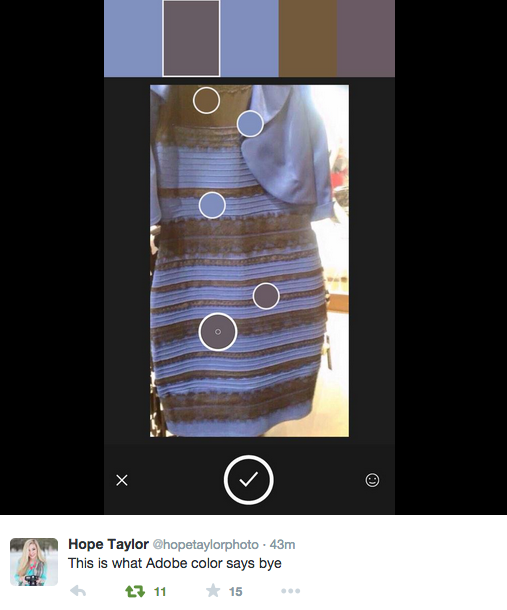
drawing out swatches of color and isolating them, to demonstrate that it really is that color? Nope. I've looked at these color swatches both ways. When the dress was white and gold for me, the swatches of color looked white and gold. The triumphant claims that this demonstrated the dress's blue and blackness looked like a joke to me. Now, the swatches are blue and black. Isolating parts of the picture and clearly presenting them had no effect on my perception.
So then why do I say it is "really blue and black"? Well, because I've seen other pictures of the dress that I trust, in other lighting, and it consistently looks blue and black. I'm confident that, outside of the very rare visual context of this photo, almost anyone would agree that it is blue and black. Of course, that has a lot to do with the range of lighting we normally experience here on Earth and a lot of broader questions about human limitations and color perception. Those are good things to keep in mind. But when I say that it is "really blue and black," the main thing I mean is that almost any person under almost any normal circumstances will perceive the dress as blue and black. When we talk about reality, that's what I think we're actually doing, most of the time...we are trying to use shared words to express shared and persistent experiences.
By looking and thinking together, I think we can arrive at more reliable descriptions of the world. And we can see through "illusions," like the illusion that the dress is white and gold. So what makes this an illusion? The fact that the perception won't persist across contexts and across people. It isn't robust. If you manipulate the environment in just the right way, the illusion can be extremely powerful, but "white and gold" provides you with an inaccurate guide to how most people (including you!) will see the dress under most conditions.
So what does this have to do with moral perception and disagreements? A great deal. When we assess the morality of a situation, it is also "presented" to our consciousness before we think about it.
We just experience something as wrong, or right. And in the same way, just willing yourself to experience someone else's perspective doesn't enable you to experience it. What's more, analyzing the situation and breaking it into little parts doesn't really help either...the same context that shapes moral perception in the first place also shapes our perception of each of the individual parts. Just like the dress and color swatches. And so people fight, become frightened and experience a profound sense of dislocation when confronted with differing moral perceptions. Sometimes, our perceptions flip, but this is often a surprising, strange and unsettling phenomenon...and it is difficult, if not impossible, to explain how it really happened.
Additionally, we experience moral disagreements as simple disagreements about matters of fact, just like two people looking at the dress. The most natural response is to simply assume that someone who sees it differently is obviously wrong. They are either being dishonest, disingenuous or have lost their minds. However, if we get past this "naively objective" phase, people will sometimes arrive at a kind of practical relativism. We toss up our hands and say that people just see things differently, and that's the end of it. One of the mysteries of the universe. This shift can represent a kind of progress, but I don't think it is quite right, either...and it certainly doesn't feel satisfying.
When it comes to dress or moral disagreement, I think we can actually resolve both, in much the same way that we can resolve disagreements about the dress. It is a matter of looking at a range of peoples' perspectives, but it is also much more than that. After all, it seems that most people see the dress in an illusory way, at first look. So in addition to looking at a range of perspectives, we also have to understand how various people see things across a range of contexts, over time. That is how we can find out what color the dress "really is." I think it works for the dress. And I think it can work for other fraught issues as well.